




Diabetes Coach
Roni AI

Adaptive coaching for the food, activity, and medication choices that happen between clinic visits. Built around the member, not a template.
- Open questions
- Autonomy support
- Change talk
- Complex reflections
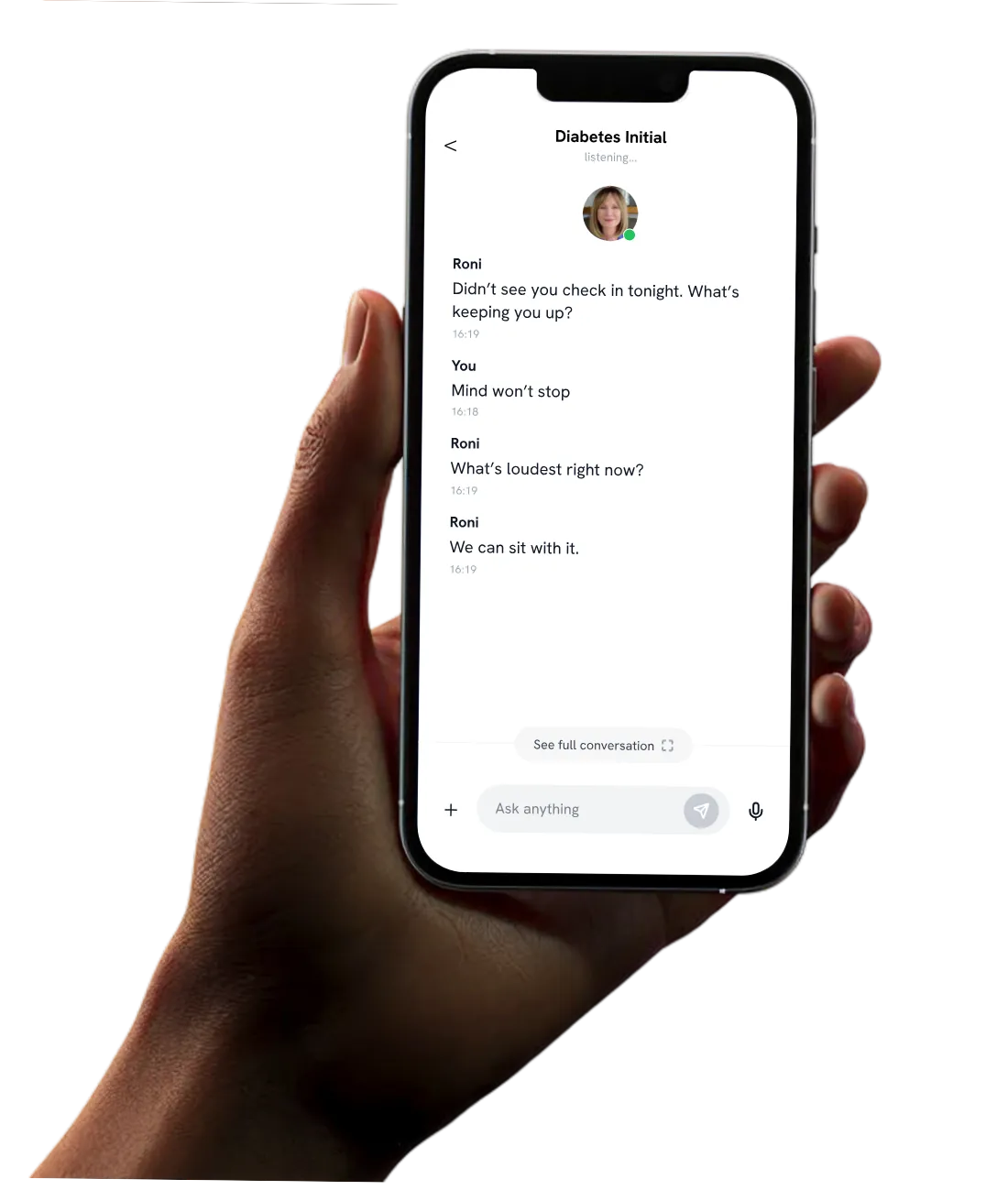
Built on the life’s work of world renowned Dr. Ken Resnicow, in Motivational Interviewing.
Book A DemoMotivational Interviewing (MI) is a collaborative way of speaking that moves through four processes, engage, focus, evoke, plan, and four micro skills called OARS: open questions, affirmations, reflective listening, summaries. Reflective listening is the workhorse.
Reflects
Mirrors back what he said, without judging.
Affirms
Recognises that he came back, an early sign of change.
Evokes
Asks what first motivated him.
Plans
Comes next, and it’s earned, not forced.
Hi James — it’s been about ten days since we last talked. Welcome back. What’s been on your mind about the eating plan?
I fell off it for two weeks. Work blew up and I just gave up.
A typical chatbot would say
No worries! Let’s get you back on track. Try logging three meals today.
Chronilogix says · MI-backed
Chief Science Officer
Dr. Ken Resnicow
30 years of research
At the heart of our platform is not just technology. It is 30 years of global experience and research from Dr. Ken Resnicow, one of the world’s foremost experts in Motivational Interviewing and Cultural Tailoring. He has spent decades guiding patients across diverse backgrounds, conditions, and cultures toward real, lasting change.
The agents
Conversational AI replies. Contextually engineered AI reasons, against the member’s prior sessions, their cultural context, and an MI fidelity rubric. The result is engagement that compounds, instead of conversation that decays.
Adaptive coaching for the food, activity, and medication choices that happen between clinic visits. Built around the member, not a template.


Reflective coaching for the 2 AM spiral and the long stretch between therapy sessions. Therapeutically informed, never prescriptive.
Three Levels of Care

Level 01
Where no other coverage exists
For the people who fall through the cracks of traditional care:

Level 02
Human + AI, working together
Combines the depth of human coaching with the consistency of AI:

Level 03
For those who prefer it this way
A growing category of demographics who get better outcomes with a fully digital coach:
One engine. Three levels. Every gap covered.

America doesn’t have a therapy shortage — it has a continuity-of-care shortage. There simply aren’t enough clinicians, coaches, care managers, or diabetes educators to provide daily support between appointments. AI coaching fills those gaps by extending the reach of the existing workforce — and replacing it where AI coaching can provide care efficaciously.
The real shortage
It’s not therapists that run short — it’s the hours between them. A therapist may see a patient once every two to four weeks, for 45 to 60 minutes, while a person with diabetes, anxiety, depression, obesity, hypertension, or heart disease makes hundreds of health decisions in between. No workforce can be there for all of them.
Care has to live in the hours between.
Proof in the field
Support between visits changes outcomes — and Dr. Resnicow’s Motivational Interviewing, the method inside Chronilogix, is what keeps people engaged in it.

53.1% → 76%member engagement, after Aetna’s care teams retrained in Dr. Resnicow’s method — dropouts cut by more than half.

58%fewer new Type 2 diabetes cases, when lifestyle support continues between appointments — the gap Chronilogix covers.
The Markets We Serve
Employers, brokers, health plans, product vendors, and wellness platforms each get a different return from the same engine — and the people who’d otherwise go unreached get a way in.
Talk to our team
What members are saying about Chronilogix AI Coaching
You don’t need to fix everything at once. Just pick one small action you’ll actually do tomorrow. That really clicked because I’ve been overwhelmed trying to change too much at once. It was simple, but exactly what I needed to hear.
See Chronilogix, white-labeled as Zenn
Our platform in action, running inside a partner's own app.
The problem, in detail
of Americans live in a Mental Health Professional Shortage Area, and more than 6,000 additional practitioners are needed just to close today’s federally designated gaps. HRSA projects shortfalls of roughly 99,780 counselors, 99,840 psychologists, 43,810 psychiatrists, 77,050 addiction counselors, and 33,840 marriage and family therapists over the next decade — and those figures reflect today’s utilization, not the full unmet need.
Source · HRSA · Health Workforce projections
global shortage of behavioral health and chronic care coaches. The world cannot hire its way out of the gap.
Source · WHO Mental Health Atlas
Americans live with at least one chronic condition. 60% of adults have one and 40% have two or more, and chronic disease drives roughly 90% of U.S. healthcare spending — demand that already outstrips the supply of nurses, diabetes educators, care managers, and health coaches. To keep up, health systems increasingly lean on care coordinators, community health workers, AI-assisted coaching, and remote monitoring.
Source · CDC
Americans live with diabetes, including 11M undiagnosed. Another 115M have prediabetes, at risk of progressing without intervention.
Source · CDC
American adults live with mental illness, 1 in 5, every year. Nearly half will meet diagnostic criteria in their lifetime.
Source · SAMHSA · National Survey on Drug Use and Health
of patients discharged from the ER after a suicide attempt never begin outpatient mental health treatment. Suicide risk runs 300× higher in the first week and 200× higher across the first month for those left without follow-up.
Source · JAMA Psychiatry · post-discharge cohort studies
in U.S. prescriptions go unfilled every year, most because of ambivalence, not forgetting. The intervention that resolves ambivalence is conversation, not reminders.
Source · Annals of Internal Medicine · WHO
is the average wait for in person mental health care. Meanwhile, human coaches stay scarce and expensive.
Source · WHO
See Chronilogix, white-labeled as Zenn
Our platform in action, running inside a partner's own app.